



Why AI Agents Won't Replace Social Media Automation Anytime Soon
Artificial intelligence has become the biggest topic in technology. Every week, a new AI agent promises to replace marketers, customer support teams, programmers, or even entire businesses. Naturally, many people are asking another question:
"Will AI agents replace social media automation tools?"
The short answer is no.
In fact, the opposite is happening.
AI agents are making automation platforms more valuable than ever because intelligence without execution has limited impact, while automation without intelligence lacks adaptability. The future of social media marketing isn't about choosing one over the other—it's about combining both into a smarter, more scalable system.
The Rise of AI Agents
AI agents represent a significant evolution beyond traditional chatbots. Instead of simply answering questions, they can:
Analyze information from multiple sources.
Make decisions based on predefined goals.
Adapt strategies as conditions change.
Coordinate multi-step workflows.
Learn from outcomes to improve future actions.
Imagine an AI agent monitoring industry conversations. It notices a competitor's product launch gaining attention, identifies the most relevant discussions, drafts personalized responses, and recommends the best engagement strategy. That's a level of contextual intelligence traditional automation alone cannot provide.
However, even after making those decisions, the work isn't finished.
Intelligence Doesn't Equal Execution
This is where many misconceptions begin.
An AI agent may know what should happen, but it doesn't automatically perform the operational work required across dozens or hundreds of social media accounts.
Someone—or something—still needs to:
Connect and maintain social media accounts.
Schedule actions across different time zones.
Execute likes, follows, comments, and posts.
Respect platform limits and pacing.
Manage proxies and account sessions.
Track campaign performance.
Monitor execution around the clock.
These repetitive, high-volume tasks are exactly what social media automation platforms are designed to handle.
Think of it this way:
AI is the strategist.
Automation is the operator.
One decides. The other delivers.
Why Automation Still Matters
Many businesses don't struggle because they lack ideas. They struggle because they can't execute consistently.
A marketing manager may know they should publish content daily, engage with new followers, monitor industry keywords, and respond quickly to conversations—but doing all of that manually across multiple platforms becomes impossible as operations grow.
Automation solves this scalability problem by handling repetitive workflows with consistency and precision.
It helps businesses:
Maintain a consistent publishing schedule.
Manage multiple social media accounts from one dashboard.
Respond faster to opportunities.
Reduce repetitive manual work.
Scale campaigns without proportionally increasing staff.
AI enhances these workflows, but it doesn't eliminate the need for them.
The Best Analogy: AI Is the Brain, Automation Is the Hands
Consider a professional chef.
The chef decides what to cook, creates recipes, adjusts flavors, and manages the kitchen. But without hands—or kitchen equipment—nothing gets prepared.
Social media marketing works the same way.
An AI agent might determine: "This trending discussion aligns perfectly with our product. We should engage immediately."
Automation then takes over by:
Identifying target posts.
Selecting the appropriate accounts.
Applying randomized delays.
Publishing approved comments.
Recording results.
Continuing execution across dozens or even hundreds of accounts.
Neither system is complete without the other.
The Future Is Hybrid Marketing
Businesses that succeed in 2026 won't replace automation with AI. They'll build intelligent systems where each component complements the other.
A modern workflow may look like this:
AI monitors conversations across multiple platforms.
AI identifies trends, opportunities, and customer intent.
AI recommends or generates content.
Automation schedules and executes approved actions.
Analytics measure performance.
AI learns from the results and refines future recommendations.
This continuous feedback loop creates marketing systems that are both intelligent and scalable.
Why Multi-Account Management Still Requires Automation
One area where automation remains irreplaceable is multi-account management.
Agencies, e-commerce brands, and global companies often manage dozens—or even hundreds—of social media accounts simultaneously.
AI may recommend the best engagement strategy, but it won't independently:
Organize account groups.
Maintain separate account sessions.
Coordinate activity timing.
Balance workloads.
Execute campaigns across multiple platforms.
Reliable automation infrastructure is still essential for these operational tasks.
Smarter Automation Is the Real Trend
The evolution isn't from automation to AI.
It's from traditional automation to intelligent automation.
Instead of blindly repeating tasks, modern platforms are becoming context-aware.
Imagine automation that can:
Detect trending conversations automatically.
Trigger workflows based on competitor activity.
Recommend the best-performing content.
Generate personalized replies using AI.
Pause campaigns when unusual activity is detected.
Adjust scheduling based on engagement patterns.
That's where the industry is heading.
How JarveePro Combines AI and Automation
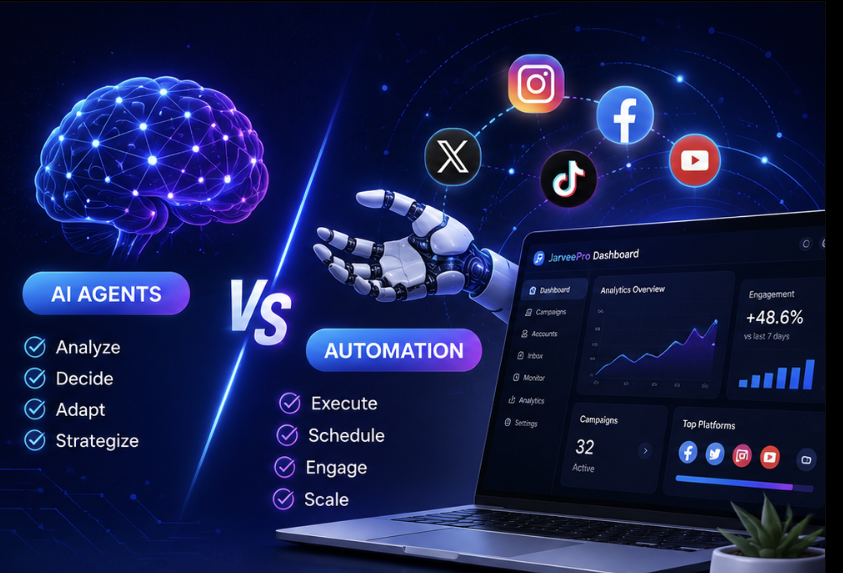
JarveePro reflects this new direction by combining intelligent monitoring with scalable automation.
Rather than simply scheduling posts, JarveePro enables businesses to build end-to-end social media workflows that include:
Multi-platform account management.
Intelligent campaign automation.
AI-powered monitoring.
Content discovery.
Performance tracking.
Workflow customization.
Scalable operations for agencies and enterprises.
Instead of replacing automation, AI enhances every stage of the workflow—helping businesses make better decisions while automation handles reliable execution.
Conclusion
The debate shouldn't be AI agents versus social media automation.
That's the wrong question.
A better question is:
How can AI and automation work together to create smarter marketing systems?
The answer is becoming increasingly clear.
AI provides the intelligence to analyze, adapt, and make informed decisions. Automation provides the consistency, speed, and scalability to turn those decisions into action.
Businesses that embrace both will spend less time on repetitive tasks, respond faster to market opportunities, and scale their social media presence more efficiently.
The future isn't AI replacing automation.
The future is AI-powered automation—where intelligent decision-making and dependable execution work together to achieve results that neither could deliver alone.