



Multi-Account Growth Architecture: Why Account Provisioning and Social Automation Are Two Entirely Different Systems
The leading cause of mass suspensions, shadowbans, and IP blocks in multi-account social media operations is an architectural flaw: confusing Account Provisioning (creation and registration) with Account Orchestration (engagement and management).
To scale digital media operations without friction, enterprise growth teams must adopt a decoupled, two-tier architecture that separates identity creation from long-term profile management.
The Core Strategic Problem: The "All-in-One" Trap
When agencies, affiliates, and growth engineers attempt to scale their social footprint across platforms like Instagram, TikTok, Facebook, or X, their instinct is to seek a single tool to handle the entire lifecycle. They want one software solution to generate accounts, pass phone verifications (PVA), bypass CAPTCHAs, post content, and drive engagement.
This unified approach frequently triggers immediate anti-fraud measures.
Modern anti-spam and behavioral telemetry engines evaluate social accounts through two distinct operational lenses:
Origin Verification & Fingerprint Identity: How, where, and under what hardware/network environment was the account born?
Behavioral Velocity & Telemetry: How does the account interact with the platform over extended cycles (time-of-day access, click patterns, dwell times, action ratios)?
Executing high-frequency registration tasks on the same pipeline used for steady, long-term audience engagement corrupts browser fingerprints, leaks proxy subnets, and alerts behavioral risk models.
To build a resilient growth infrastructure, digital operations must separate their technology stack into
System 1: The Provisioning Layer and System 2: The Orchestration Layer.
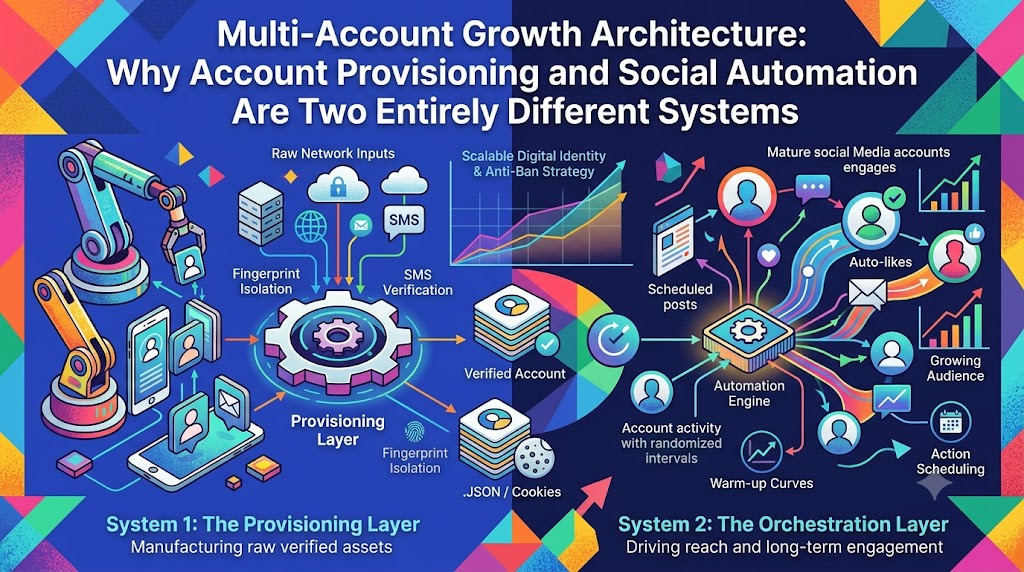
System 1: The Account Provisioning Layer (e.g., PVACreator)
The Provisioning Layer functions as an industrial assembly engine. Its sole objective is to yield verified, isolated, and verifiably unique social media identities at volume while minimizing cost-per-account (CPA).
Core Technical Responsibilities:
Fingerprint Isolation: Synthesizing isolated browser runtime environments (WebGL, Canvas, AudioContext, Client Hints, WebRTC handling) to ensure zero cross-profile contamination.
SMS & CAPTCHA Integration: Interfacing directly with SMS gateways and third-party CAPTCHA solvers via local or remote APIs.
Registration Protocol Execution: Automating form completion, email confirmation, and initial profile parameter assignment.
Portable Session Packaging: Exporting valid session data—specifically cookies, user-agent strings, and local storage state—into standardized files for seamless migration.
Rule of Provisioning: The Provisioning Layer's role ends the moment a verified account is minted and its session state is successfully exported. Running continuous daily engagement through an engine built for high-throughput creation introduces unnecessary risk.
System 2: The Account Orchestration Layer (e.g., JarveePro)
The Orchestration Layer is an account management and behavioral simulation environment. Its objective is long-term profile retention, audience expansion, and automated marketing execution across seasoned account fleets.
Core Technical Responsibilities:
Behavioral Telemetry Simulation: Introducing non-linear cursor paths, random feed scrolling, varied dwell times, and context-aware interactions.
Warm-Up Curve Management: Gradually ramping action limits over 14 to 30 days to build platform trust before initiating aggressive marketing campaigns.
Network & Proxy Binding: Locking individual profiles to static, dedicated residential or 4G/5G mobile proxies to maintain a consistent IP fingerprint over time.
Multi-Account Campaign Scheduling: Executing content publishing, automated direct messaging, auto-following, and engagement threads across hundreds of active accounts simultaneously.
Architectural Comparison: Provisioning vs. Orchestration
Understanding the underlying technical differences between these systems explains why all-in-one tools often underperform:
Operational Mandate
Provisioning Layer (PVACreator): High-volume asset creation & phone/email verification
Orchestration Layer (JarveePro): Profile retention, audience engagement & distribution
Network Profile
Provisioning Layer (PVACreator): Rapid, short-burst connections across dynamic IP pools
Orchestration Layer (JarveePro): Persistent, long-term sessions bound to static residential/4G IPs
Primary Risk Factors
Provisioning Layer (PVACreator): Canvas detection, WebRTC leaks, blocked phone number ranges
Orchestration Layer (JarveePro): Action velocity flags, rate limits, abnormal engagement spikes
API / Browser Runtime
Provisioning Layer (PVACreator): Multi-threaded browser automation optimized for registration workflows
Orchestration Layer (JarveePro): Behavior engines simulating natural usage patterns
Primary System Output
Provisioning Layer (PVACreator): Raw verified accounts (Cookies / Tokens / Credentials)
Orchestration Layer (JarveePro): Impressions, reach, direct messages, and referral traffic
The 3-Stage Blueprint for Reliable Growth Operations
To build a scalable multi-account infrastructure that resists platform updates, enterprise operations structure their deployment pipeline into three distinct phases:
Phase 1: Batch Provisioning & Identity Verification
Dedicated creation software like PVACreator executes registration tasks using clean proxies, automated SMS routing, and CAPTCHA solving. The resulting profile states (cookies, user-agents, and credentials) are dumped into an isolated repository.
Phase 2: Session Quarantine & Passive Aging
Session cookies are imported into an isolated multi-account runtime or anti-detect environment. Accounts sit in a Quarantine Phase for 7–14 days performing light, passive actions (e.g., loading home feeds, reading posts) to build initial browser cookie history without triggering active engagement algorithms.
Phase 3: Orchestration & Campaign Scaling
The aged account profiles are transferred into an automation orchestrator like JarveePro, bound to static 4G/5G mobile proxies matching the target geo-location. Conservative warm-up schedules cap actions at low thresholds and increase velocity by 10–15% weekly.
Conclusion
Comparing PVACreator and JarveePro as direct competitors is an operational mistake. They perform complementary functions within an enterprise media stack:
PVACreator acts as the manufacturing engine, supplying fresh, verified account assets.
JarveePro acts as the management framework, driving reach, engagement, and conversion across those assets.
Decoupling creation mechanics from growth workflows reduces account bans, improves proxy efficiency, and establishes a predictable foundation for digital scaling.