



The AI Infrastructure Race: Why Data Centers Are Becoming the New Industrial Debate
Introduction
The AI revolution was supposed to be invisible.
Unlike factories, railways, or power plants from previous industrial revolutions, artificial intelligence was imagined as something that lived in the cloud — accessible from anywhere, powered by algorithms, and limited only by imagination.
But the reality of AI is becoming increasingly physical.
Behind every AI chatbot, image generator, autonomous system, and enterprise AI application is a massive infrastructure network:
- data centers
- advanced chips
- electricity generation
- cooling systems
- fiber networks
- specialized engineers
The next phase of AI is not only a race to build smarter models.
It is a race to build enough computing power to support them.
And that race is creating a new wave of public debate.
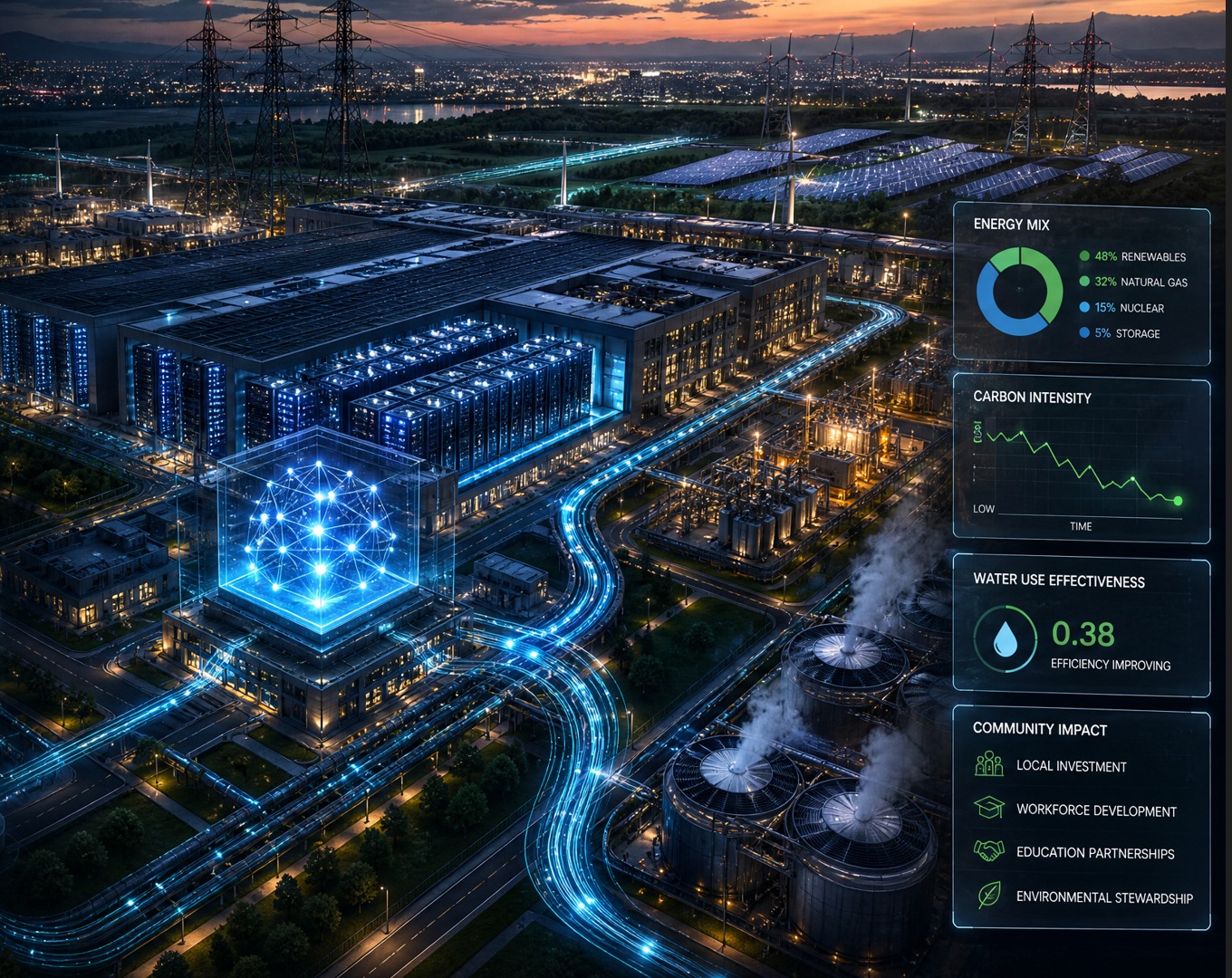
The New Reality: AI Requires Industrial-Scale Infrastructure
For years, technology companies described AI as software innovation.
But modern AI depends on enormous physical resources.
Training and operating advanced AI models requires:
- thousands of GPUs
- large-scale data centers
- reliable energy supplies
- sophisticated cooling systems
The size of future AI infrastructure is difficult to imagine.
Some planned AI facilities are measured not in megawatts, but gigawatts.
One gigawatt of electricity is roughly comparable to the power consumption of a large city.
This means AI development is increasingly connected to questions traditionally associated with heavy industries:
- Where will the electricity come from?
- Who pays for new infrastructure?
- How will communities be affected?
- How many jobs will actually be created?
Why Are Communities Pushing Back Against AI Data Centers?
The AI industry expected enthusiasm.
Instead, some communities are asking difficult questions.
Across different regions, opposition has grown around several concerns:
1. Energy Consumption
Data centers require enormous amounts of electricity.
As AI adoption accelerates, demand for computing power increases.
Energy regulators and utilities are now dealing with a new challenge:
How can power grids support AI expansion without increasing costs for ordinary consumers?
2. Water and Environmental Concerns
Many large data centers rely on cooling systems that require significant resources.
Residents near proposed facilities have raised concerns about:
- water usage
- noise pollution
- land development
- environmental impact
The debate increasingly resembles previous conflicts around energy infrastructure projects.
3. The Jobs Question
One of the biggest concerns is economic:
"If AI requires billions of dollars in infrastructure, will ordinary workers benefit?"
Technology companies argue that AI will create new opportunities:
- AI engineers
- data center technicians
- infrastructure specialists
- new AI-powered businesses
Critics worry that AI automation could replace some existing roles faster than new jobs appear.
This creates a fundamental question:
Will AI create a new economic opportunity, or will the benefits be concentrated among a small group of companies and investors?
The AI Debate Is Becoming a Social Contract Debate
Every major technology revolution has faced resistance.
The automobile changed transportation.
Electricity transformed society.
The internet reshaped communication.
But each transformation required society to answer difficult questions:
- Who benefits?
- Who carries the costs?
- How should governments regulate growth?
AI is now facing the same moment.
The challenge is not simply:
"Can we build better AI?"
The challenge is:
"Can we build AI infrastructure in a way that earns public support?"
The Race for Compute Power
The AI industry has entered an era where computing capacity has become a strategic resource.
Companies are competing for:
- advanced chips
- energy contracts
- data center locations
- engineering talent
The winners of the AI race may not only be companies with the best algorithms.
They may be companies that can successfully combine:
AI models + computing infrastructure + energy resources.
This is why major technology companies continue investing heavily in AI infrastructure.
Why This Matters for Businesses
For businesses, the AI debate does not change the fundamental opportunity.
AI adoption will continue.
Companies are already using AI for:
- marketing automation
- customer service
- content creation
- software development
- business analytics
However, businesses should understand that AI is not just a software upgrade.
It represents a broader transformation in how digital products and services are built.
The future belongs to companies that can combine:
- human creativity
- AI capabilities
- automation systems
- digital distribution
The Future: Responsible AI Growth
The AI industry may need to learn an important lesson from previous industrial transformations.
Technology alone is not enough.
Successful innovation requires trust.
The next generation of AI companies will need to focus on:
- efficient energy usage
- sustainable infrastructure
- workforce education
- transparent communication
- community engagement
The question is no longer whether AI will grow.
The question is whether AI growth can happen in a way that benefits society broadly.
Conclusion
The AI revolution has entered a new stage.
The biggest challenge is no longer proving that AI works.
The challenge is building the physical and social infrastructure needed to support it.
As data centers expand from millions of servers to gigawatt-scale computing facilities, the AI industry must address concerns about energy, jobs, and public trust.
The future of AI will not only be determined by algorithms.
It will also be determined by whether society accepts the infrastructure required to power them.