



How to Find Customers on X (Twitter): A Smarter B2B Marketing Strategy
How to Find Customers on X (Twitter): Turn Real Conversations Into Business Opportunities
Your next customer may already be describing the problem you solve. The challenge is knowing where to look, what to say, and when to engage.
Most businesses use X (formerly Twitter) to publish content.
They share product announcements, industry news, promotional offers, and the occasional viral post. Then they measure success through impressions, likes, reposts, and follower counts.
But what if the most valuable marketing opportunity on X isn't publishing another post?
What if it's finding someone who is already looking for a solution?
Every day, people ask for recommendations, complain about existing products, compare suppliers, discuss business challenges, and look for better ways to work.
These conversations can reveal customer needs long before someone fills out a contact form or searches for a particular brand.
For businesses willing to listen, X can become more than a content distribution platform.
It can become a source of customer intelligence.
1. Stop Searching for Followers. Start Searching for Problems.
Imagine you sell commercial lawn-mowing equipment.
A traditional social media strategy might focus on hashtags such as #LawnCare, #Landscaping, and #CommercialMowers.
You publish product photos, follow industry accounts, and hope potential buyers discover your business.
But consider these hypothetical posts:
“Our landscaping equipment keeps breaking down during peak season. Any recommendations for something more reliable?”
“Looking for a commercial mower supplier with dependable replacement parts.”
“Has anyone compared the maintenance costs of different zero-turn mower brands?”
These conversations are more commercially meaningful than a random post about lawn maintenance.
Why?
Because they reveal specific problems, purchasing considerations, or requests for advice.
A person discussing equipment reliability may not be ready to buy today. But their question offers an opportunity to understand what matters to potential customers.
The first step in customer acquisition is identifying a problem worth solving—not finding an excuse to promote your product.
2. Recognize the Different Signals of Buying Intent
Not every mention of your industry represents a potential customer.
Someone posting a photograph of their lawn is different from a landscaping contractor asking for equipment recommendations.
The distinction becomes clearer when you classify conversations by intent.
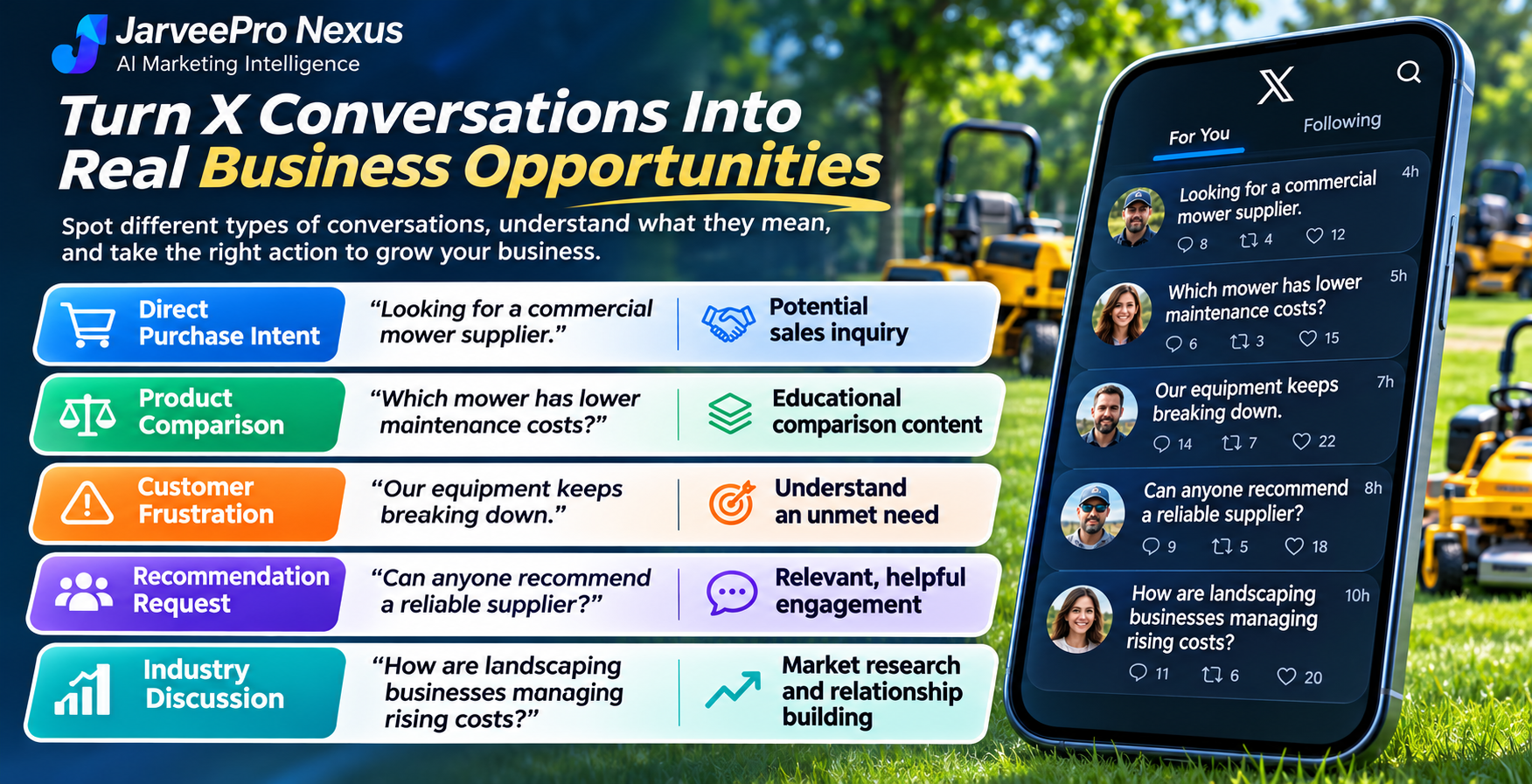
The goal isn't to label every person as a lead.
It's to distinguish casual conversations from those where your expertise could genuinely help.
This also applies beyond manufacturing.
A marketing agency might discover a business owner struggling with customer acquisition.
A cybersecurity provider might find discussions about evaluating security solutions.
A software company might encounter users looking for alternatives to complicated workflows.
Different industries, same principle:
Customers often describe their needs before they describe the product they want.
3. Search Like a Customer, Not a Marketer
Most businesses search X using their own product terminology.
A company selling marketing automation might monitor phrases such as “social media automation software.”
But potential customers may never use those words.
Instead, they might write:
“I'm spending too much time posting on social media.”
“How do agencies manage so many client accounts?”
“Is there a way to publish content across different platforms?”
“Our marketing team can't keep up with content production.”
“How do I find potential B2B customers on Twitter?”
These are descriptions of problems rather than product categories.
A useful research strategy combines three types of language:
Product language: The terminology sellers use.
Problem language: The frustrations and operational challenges customers describe.
Decision language: The questions customers ask when comparing solutions.
For example, someone asking “Which social media management tool should I choose?” is at a different stage from someone saying “I can't keep up with publishing.”
Both conversations matter, but they require different responses.
The first may benefit from a feature comparison.
The second may need a better understanding of the underlying workflow.
This is why customer research should begin with how buyers speak—not simply how companies describe their products.
4. Study Competitor Conversations to Discover Unmet Needs
Competitor research isn't just about watching what other companies publish.
Often, the more interesting information appears in the conversations around their products.
Consider a business evaluating competing marketing platforms.
A competitor may advertise an impressive collection of features.
But its customers might repeatedly ask about setup complexity, account management, reporting, workflow reliability, or integrations.
Those questions reveal something important:
A feature list tells you what a company sells. Customer conversations tell you what buyers still need.
A useful competitor research process examines public discussions for recurring themes:
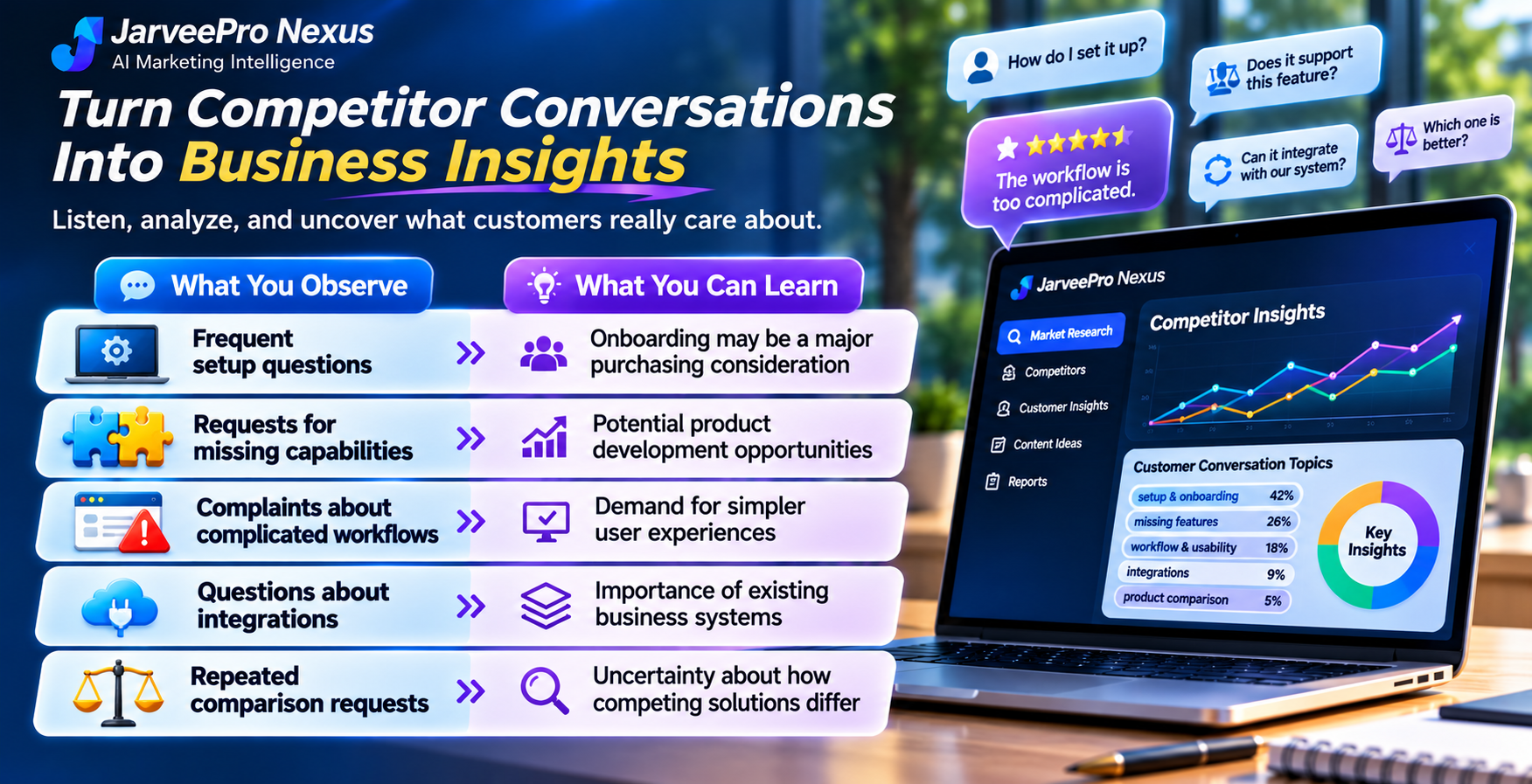
These findings can inform product development, customer education, positioning, and marketing content.
They should not automatically be treated as proof that a competitor is failing. A handful of social posts may not represent its broader customer base.
The real value comes from identifying patterns and validating them against other evidence.
5. Turn Customer Questions Into Content People Actually Need
Once you understand what potential customers are asking, your content strategy becomes much easier to develop.
Imagine you discover repeated questions about commercial mower maintenance costs.
Instead of publishing another product advertisement, you could create:
A short X post: Three maintenance expenses buyers often overlook.
A comparison guide: How to evaluate the total cost of ownership of commercial mowing equipment.
A YouTube video: What to inspect before purchasing a commercial mower.
A LinkedIn article: How equipment downtime affects landscaping business profitability.
A website resource: A checklist for evaluating suppliers and replacement-part availability.
One recurring customer concern becomes several useful educational assets.
More importantly, those assets can help buyers make informed decisions.
This is where market research begins to influence content production.
Rather than asking your marketing team to invent something new every day, you give them a clearer assignment:
Answer the questions your future customers are already asking.
6. JarveePro Nexus Workflow
Finding relevant conversations manually is useful at the beginning.
But as your business expands across industries, markets, and social media accounts, researching every topic and preparing content becomes increasingly time-consuming.
This is where JarveePro Nexus can support a more structured marketing operation.
Instead of treating automation as the starting point, businesses can use it after defining their customer segments, research topics, and content objectives.
A practical workflow might look like this:
Discover relevant audiences and discussions
Use supported audience and content discovery capabilities to research relevant topics, public conversations, and potential customer segments.
Where available, search and monitoring workflows can help organize ongoing research.
Analyze recurring customer needs
Review the collected information to identify common questions, frustrations, comparisons, and content opportunities.
AI can help summarize and categorize findings, while a human verifies whether the conclusions are meaningful.
Develop relevant content
Use JarveePro Nexus's AI-assisted content creation capabilities to prepare educational posts, explanations, and other content based on validated customer questions.
Publish across appropriate platforms
Organize content and use supported publishing workflows to distribute it across relevant social channels.
The objective is not to publish identical promotional messages everywhere.
Different platforms serve different audiences and content formats.
Evaluate what produces business value
Measure useful engagement, relevant website visits, inquiries, and conversions where tracking is available.
Use those results to improve the next round of research and content.
The workflow is straightforward:
Research customer needs. Develop useful content. Publish appropriately. Learn from the response.
JarveePro Nexus helps organize and automate supported parts of that process.
It does not replace market understanding, customer relationships, or human sales judgment.
7. Don't Confuse Automation With Customer Relationships
There is an important difference between identifying potential customers and treating every relevant social media account as a target for automated outreach.
A person discussing a business problem has not necessarily invited a sales pitch.
Unsolicited repetitive replies, mass mentions, and automated direct messages can damage credibility and violate platform rules.
A better approach is to contribute when you have something useful to offer.
For example, if someone asks how to evaluate commercial mower maintenance costs, a manufacturer could explain which factors buyers should compare.
If the person requests further information, the conversation can develop naturally.
This is more valuable than sending the same sales message to hundreds of accounts.
Automation should reduce repetitive work. It shouldn't automate away the judgment that makes a conversation worth having.
8. Measure Customers, Not Just Conversations
A campaign that generates thousands of impressions but no relevant business inquiries may need a different strategy.
Likewise, a smaller campaign that produces a few qualified conversations could be more valuable.
For X-based customer acquisition, useful metrics include: 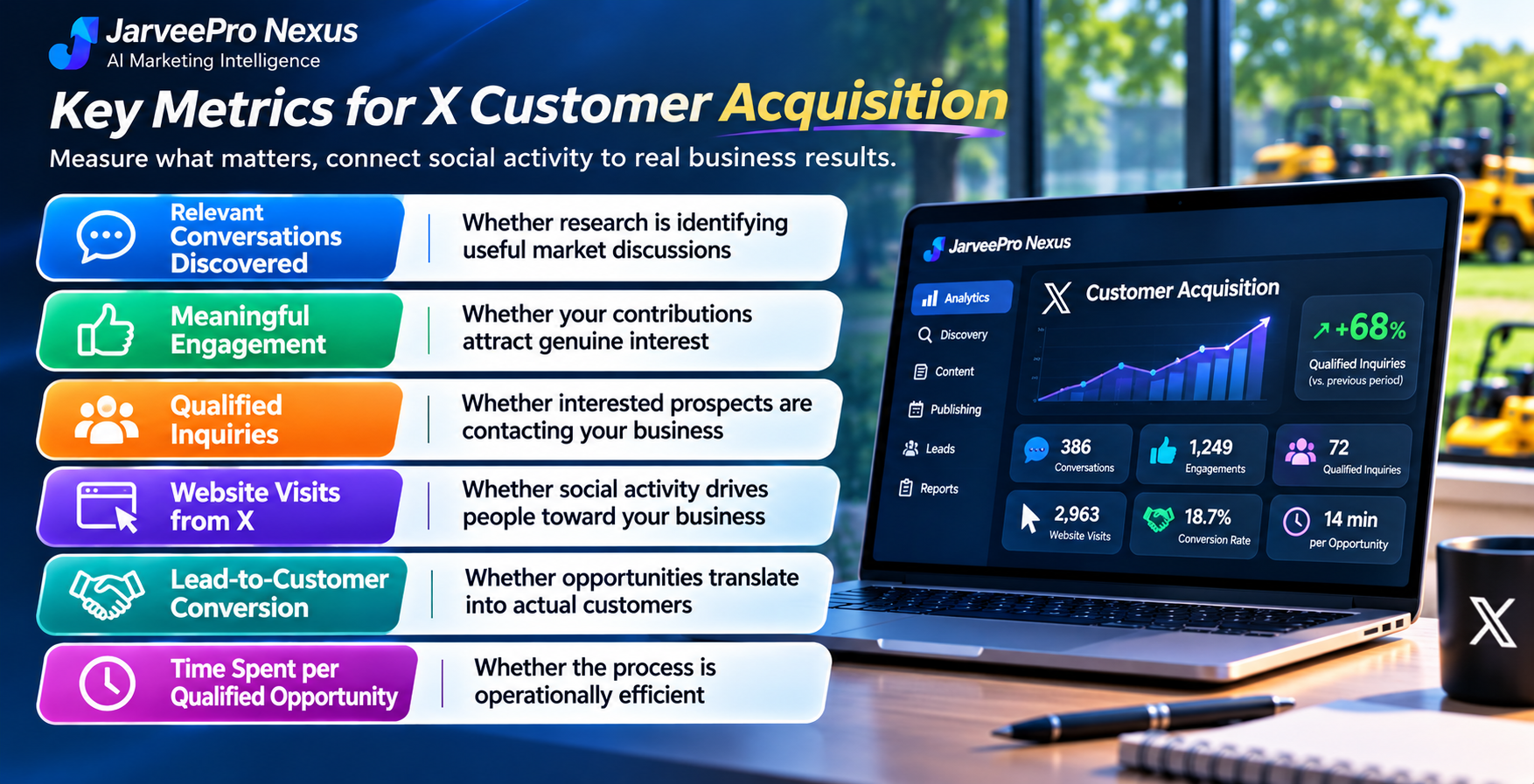
These metrics connect social media activity with commercial outcomes.
They also help answer a question that every business should ask:
Are we building an audience, or are we building a business?
The two can support each other, but they are not interchangeable.
9. A Practical 30-Day Customer Discovery Plan
You don't need to begin with ten platforms or hundreds of accounts.
Start with one industry, one target market, and a clearly defined customer problem.
Week 1: Understand your buyers
Identify customer segments, purchasing concerns, relevant keywords, and the accounts or communities where industry conversations occur.
Week 2: Research and validate
Study relevant X conversations, competitor discussions, and recurring customer questions. Separate genuine opportunities from general chatter.
Week 3: Publish and engage
Develop useful content around validated concerns. Participate selectively in relevant conversations and test which topics attract meaningful interest.
Week 4: Measure and improve
Review qualified inquiries, website traffic, content performance, and the time required to maintain the workflow.
Decide which topics deserve more attention and which activities should stop.
As the process becomes repeatable, JarveePro Nexus can help manage supported content and automation workflows without requiring the team to rebuild everything manually.
Conclusion: Your Next Customer May Already Be Talking
Social media marketing is often presented as a competition for attention.
More posts. More followers. More impressions.
But customer acquisition begins with understanding demand.
Somewhere on X, a potential buyer may be comparing suppliers, asking for recommendations, or describing a frustrating problem.
The opportunity is not simply to interrupt that conversation with an advertisement.
It's to understand the need, contribute something useful, and become a credible option when the customer is ready.
AI can make research and content preparation more efficient.
Automation can help businesses maintain consistent workflows.
And tools such as JarveePro Nexus can support the operational side of that strategy.
But the most important capability remains human:
Knowing which conversations matter—and why.
Explore AI-Powered Social Media Marketing
Want to build a more structured process for audience discovery, content development, and social media management?
Explore JarveePro Nexus and discover how AI-assisted marketing workflows can support your business.
Start with your customers. Then decide what to automate.