



AI Can Write Code… But It Can’t Build Products Like This
There’s a growing belief floating around tech circles that feels almost too clean to be true:
“If AI can generate code, then building software is basically solved.”
It sounds nice. Efficient. Almost like software engineering just got downgraded into “describe → generate → deploy.”
But anyone who has actually built real systems in the wild knows this is where reality taps you on the shoulder and says: not even close.
Because AI can write code.
But it doesn’t build products that survive the real world.
The Illusion of “Perfect AI Software”
Tools like ChatGPT or Codex are incredibly good at one thing: translating intent into syntax.
You say:
“Build me a login system with X, Y, Z”
And boom—you get code.
Clean. Structured. Sometimes even impressive.
But here’s the problem most people don’t see:
That code has never lived under pressure.
It has never faced:
- 10,000 concurrent sessions
- Broken browser states
- Real users clicking the wrong thing at the worst possible time
- Platform updates that silently break assumptions
- Or edge cases that only show up at 3 a.m. in production
AI writes possible software.
Real products are built for unpredictable reality.
Those are very different worlds.
Why “Just Build It With AI” Breaks in Practice
The assumption is simple: “If I can describe it, AI can build it.”
But software doesn’t fail in obvious places.
It fails in the weird ones.
The ones nobody puts in prompts.
Things like:
- Timing drift between processes
- Session persistence breaking across environments
- Device fingerprint inconsistencies
- API behavior changing without warning
- Race conditions that only appear under load
And the worst part?
You don’t discover these in development.
You discover them when users are already inside the system.
That’s the moment where theory stops mattering.
Real Products Are Not “Code Projects”
Let’s take something like PVACreator as an example of what real systems actually are.
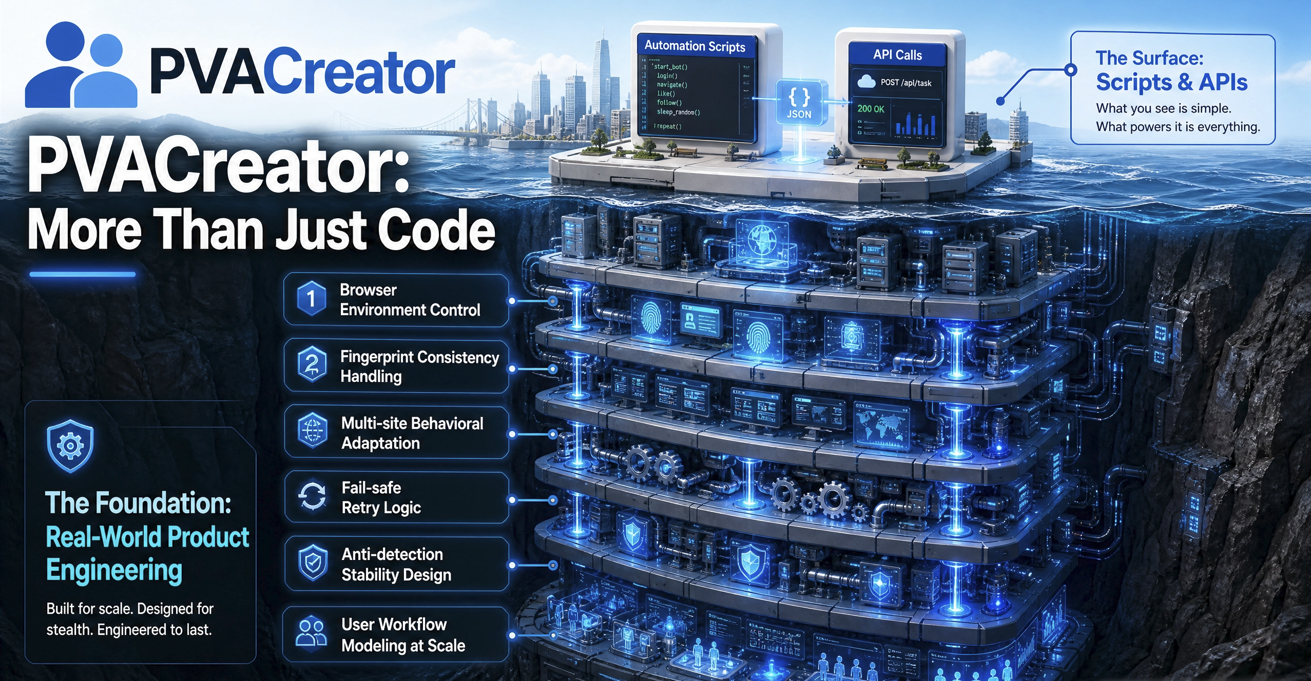
From the outside, people often assume it’s just:
- automation scripts
- browser control
- maybe some API calls
But that’s like saying a city is “just buildings.”
In reality, products like this are layered systems built from:
- Browser environment control systems
- Fingerprint consistency handling
- Multi-site behavioral adaptation
- Fail-safe retry logic
- Anti-detection stability design
- User workflow modeling at scale
And most importantly:
They’re shaped by years of watching how real users break things unintentionally.
Because users don’t follow your design.
They stress it.
Constantly.
The Hidden Ingredient AI Doesn’t Have: Accumulated Failure
Here’s something uncomfortable but true:
Most strong software isn’t built from success.
It’s built from failure logs.
Real product development is basically:
- ship something
- watch it break in a new way
- patch it
- discover a second failure you didn’t predict
- repeat for years
AI doesn’t “remember” those scars unless you explicitly feed them in.
And even then, it doesn’t feel their importance in system design decisions.
That’s where human engineers still dominate:
They don’t just know what works.
They remember what used to fail spectacularly.
Why Scale Changes Everything AI Doesn’t Simulate Well
A common blind spot is assuming: “If it works for one user, it works for all users.”
That assumption dies fast.
At scale, everything mutates:
- Small delays become cascading failures
- Rare edge cases become daily occurrences
- “Optional checks” become critical safeguards
- Minor UI timing issues become full workflow blockers
This is where real systems stop being “codebases” and become ecosystems.
And ecosystems are messy.
AI is good at designing clean logic chains.
But real products are built on top of chaos management.
The Engineering Stack Is Only Half the Story
Yes, systems like this involve:
- C#
- Browser automation layers
- Session management logic
- Scheduling engines
- Proxy routing systems
But here’s the part people miss:
The hardest problems are not technical.
They’re behavioral.
Questions like:
- How do users actually operate this at 2 a.m. on a VPS?
- What happens when they misunderstand the workflow?
- What if they run 50 accounts instead of 5?
- What if the platform changes UI layout overnight?
- What if they ignore best practices entirely?
AI can generate architecture diagrams.
But it doesn’t naturally design for human unpredictability under pressure.
Why “Prototype Code” and “Production Systems” Feel Nothing Alike
This is where a lot of developers get misled by AI.
You ask for a script → it works.
You assume scaling it is linear → it’s not.
A quick prototype might:
- log in successfully
- execute tasks
- return clean results
But production systems need:
- retries without duplication
- state recovery after crashes
- distributed consistency
- long-running stability
- defensive design against unknown failures
That gap is where most “AI-built apps” collapse.
Not because the code is wrong.
But because the system design was never tested against reality.
The Real Skill: Designing for What You Don’t Control
If there’s one thing experienced builders learn (often the hard way), it’s this: You are not building for the happy path. You are building for everything else.
That includes:
- broken sessions
- unexpected user behavior
- partial failures
- platform instability
- timing mismatches
- silent API changes
This is why strong products feel “boringly reliable” from the outside.
That boring reliability is actually years of invisible engineering.
AI Is an Accelerator, Not a Builder
AI absolutely changes the game.
It:
- speeds up development
- helps explore ideas
- generates boilerplate
- assists debugging
- lowers entry barriers
But it does not replace the core loop of real product building:
- experience
- iteration
- field feedback
- system thinking under constraints
- and long-term adaptation
That’s why a real product is never just “code that runs.”
It’s code that keeps working when everything else refuses to behave.
And that difference?
That’s the entire game.