



Why I Use IPFarming with JarveePro: A Real Social Media Marketer’s Infrastructure Stack
Most people think social media platforms detect automation by looking at what you do.
They don’t.
They detect automation by looking at where you exist.
This is the part almost nobody understands.
Not beginners. Not intermediate users. And surprisingly, not even many advanced automation users.
I learned this the hard way.
Platforms Don’t Trust Accounts. They Trust Environments.
An account isn’t trusted. An environment is trusted.
Every time an account logs in, platforms silently build an environment profile around it. That profile includes:
IP history over time
ASN ownership (not just IP, but the network behind it)
IP stability patterns
IP “behavioral neighbors”
Session continuity
This last one is the killer.
Behavioral neighbors.
Your account isn’t judged alone. It’s judged based on what other accounts exist on the same IP range.
Not just your IP.
The entire network block.
The "Bad Neighborhood Effect" Nobody Talks About
Here’s what most automation users don’t realize:
Even if your automation behavior is perfect, your account can still be flagged if it shares infrastructure with bad actors.
This is called network-level trust scoring.
If 200 other accounts on nearby IPs are:
Creating accounts aggressively
Sending spam
Getting banned
Your account inherits suspicion automatically.
Not because of what you did.
But because of where you exist.
I saw this happen repeatedly.
Accounts that were behaving perfectly were getting flagged, while others with more aggressive automation survived.
The difference wasn’t automation settings.
It was IP infrastructure quality and isolation.
What Get Accounts Flagged? Infrastructure Does.
This is important.
JarveePro executes actions.
It doesn’t define identity.
Identity is defined by infrastructure.
You can run the safest automation settings in the world, but if the IP environment is unstable, platforms detect inconsistency.
Here’s an example of what platforms see:
Account logs in from IP A on Monday.
Same account logs in from IP B on Wednesday.
IP B belongs to a network associated with hundreds of automation accounts.
This creates an identity fracture.
From the platform’s perspective, the account is no longer a person.
It’s an object moving between environments.
That’s unnatural.
That’s detectable.
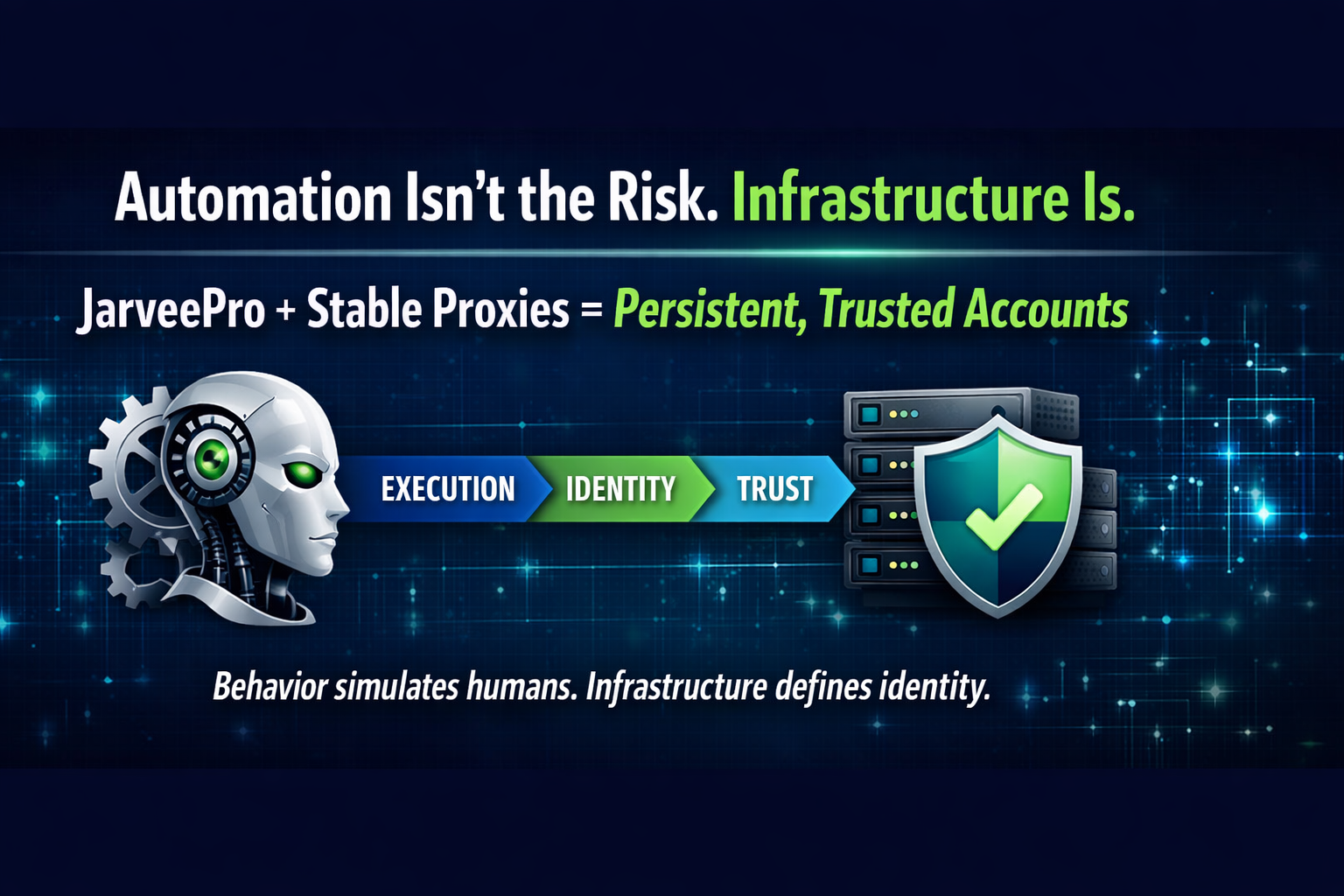
JarveePro Executes Automation. Infrastructure Defines Identity.
JarveePro handles behavioral execution—actions such as posting, following, messaging, and engagement.
But JarveePro does not create or define network identity.
Identity is defined by the proxy infrastructure connected to it.
This distinction is important.
JarveePro is the automation engine.
Proxy infrastructure, such as IPFarming, provides the stable network environment that allows JarveePro to operate consistently.
They serve completely different roles.
One handles execution.
The other handles environmental continuity.
Not competitors. Complementary layers.
Platforms Track Time Consistency More Than Behavior
This is the part that surprised me the most.
Time consistency matters more than action patterns.
If an account exists on the same IP environment for weeks and months, platforms start treating it differently.
It becomes trusted infrastructure.
Even automation becomes normalized within that trusted environment.
This is why some accounts can automate heavily for years, while others get flagged within days.
It’s not the tool.
It’s the environment stability curve.
Automation Is No Longer About Actions. It’s About Environmental Continuity.
The real game isn’t automation anymore.
It’s environmental simulation.
JarveePro handles behavioral simulation.
IPFarming handles environmental continuity.
Together, they replicate something platforms trust:
Persistence.
Real users persist in the same environment.
Disposable automation environments don’t.
Platforms know the difference.
The Turning Point: When My Accounts Started Aging Instead of Resetting
Before fixing infrastructure, my automation lifecycle looked like this:
Create → Grow → Flag → Replace → Repeat
After stabilizing infrastructure, the pattern changed:
Create → Grow → Age → Stabilize → Scale
Accounts started accumulating trust instead of resetting constantly.
That’s when automation becomes scalable.
Not when accounts grow fast.
But when they survive long enough to mature.
What Most Automation Users Never Realize
Automation failure isn’t usually caused by doing too much.
It’s caused by existing inconsistently.
Platforms tolerate automation far more than people think.
They don’t tolerate unstable identity environments.
That’s the real detection vector.
And it’s invisible to most users.
Why IPFarming Became Permanent Infrastructure in My Stack
JarveePro is the execution layer.
IPFarming is the identity layer.
Without identity continuity, execution doesn’t matter.
With identity continuity, automation becomes sustainable.
Not temporary.
Not fragile.
But persistent.
And persistence is what platforms trust most.